
The Laser Centre is the largest laser resource in Latvia and a unique experimental infrastructure at national and regional (Baltic States) scale. It was established in 2005 by a major investment of the University aimed at facilitating high-level research education embedded in the environment of a modern research laboratory. The infrastructure of the Laser Centre houses a laser pool consisting of several single mode ring dye laser systems that provide the necessary number of coherent light sources for complex laser manipulation experiments, and various diode laser sources. An incorporated teaching laboratory serves as the training ground for students in handling complex laser systems. It allows the researchers to perform experiments with supersonic molecular beams, reaction fragment imaging, Fourier spectrometry, and a magneto-optical trap for cold atom experiments is being built.
The Laser Centre was established as an open facility, with an idea to provide access to interested external researchers willing to use its infrastructures. It has become de facto the leading and largest laser laboratory in Latvia, with its researchers actively working in the areas of atomic, molecular, and chemical physics, astrophysics, as well as various kinds of applications of laser techniques. The scope of this research is reflected in regular publications in international scientific journals (like Phys. Rev. Lett., Phys. Rev. A, J. Chem. Phys., J. Phys. B etc.).
Research in the Laser Centre is structured topically in its four laboratories:
Atomic and Molecular Physics Laboratory (Dr. Phys. M. Mozers)
Molecule Optical Polarization Laboratory (Prof. R. Ferber)
Laboratory of Astrospectroscopy (Dr. Phys. K. Pukitis)
Color centre laboratory (NV in diamond) (Prof. M. Auzinsh)
During more than ten years of existence the Laser Centre has become the strongest scientific centre of laser based research, with ongoing research activities and training of PhD students and postdocs. The Laser Centre has numerous international collaborations with partners in most European countries, as well as USA and Taiwan. It has been successful in attracting funding from European Framework Programmes, NATO, INTAS, and EC structural funds. It has also achieved a good degree of visibility at national scale, considered to be a national model laboratory, which is evidenced by interviews of the mass media and regular open door events accepting the ground and secondary school students and science teachers. The Laser Centre welcomes interested researchers and students to communicate about possible collaborations and study options.
The Quantum Sensing Laboratory at the Laser Centre focuses on nitrogen-vacancy (NV) centers in diamonds in the following fundamental and application-oriented research areas:
- Basic research of NV centers in diamonds.
- Development and compactization of vector magnetometers.
- Wide-field imaging of magnetic fields.
- Fabrication and characterization of NV sensors.
Scope.—
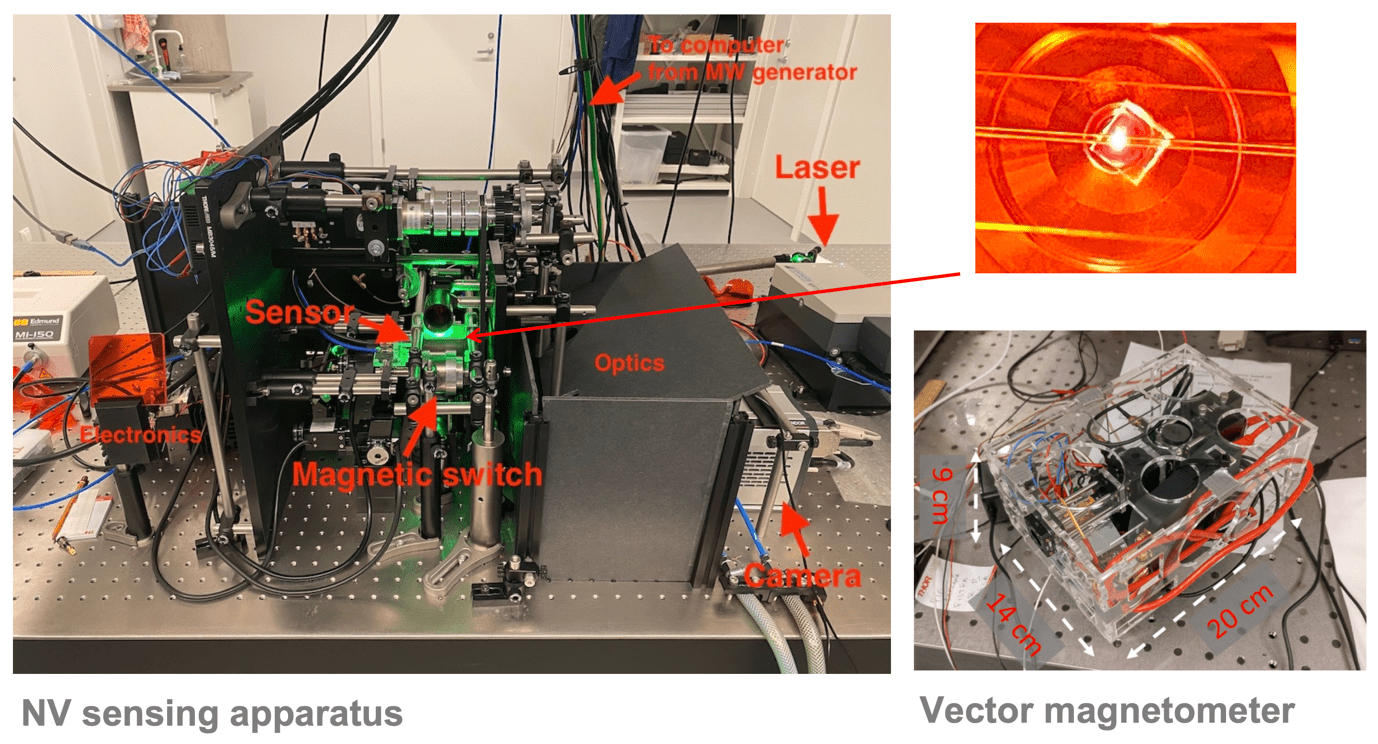
Because of their robustness, simplicity, and high spatial resolution, NV centers in diamond provide possibly the most promising approach to developing practical quantum sensors. Significantly, they form the basis for the first quantum technology that has been commercialized (scanning NV microscopes) and new applications and techniques are continuously being developed. Our laboratory is on the cutting edge of this development. The laboratory has several setups for NV magnetometry, including a unique wide-field magnetic imaging microscope capable of mapping magnetic fields with optical resolution in real-time. In addition, the laboratory facilities enable fabrication and characterization of quantum sensors with ensembles of NV centers in diamond, as well as advanced pulsed magnetometry experiments. Our laboratory students gain expertise in the development and construction of compact NV magnetometers for space and navigation applications within the framework of several international projects.
International cooperation.—
Our cooperation with several leading labs and experts in Europe and North America leads to joint research and publications, as well as the exchange of visiting scientists and students. Specifically, these experts are Prof. Dmitry Budker at Berkeley and Mainz universities, Prof. Victor Acosta at the University of New Mexico, Prof. Abdelghani Laraoui of the University of Nebraska and many others.
Expertise in the physics of NV centers
-Ilja Fescenko (Senior Researcher, ORCID ,
-Florian Gahbauer (Senior Researcher, ORCID,
-Marcis Auzinsh (Prof., ORCID,
The main focus in atomic physics is on coherent effects in atomic systems such as zero and non-zero field magneto-optical resonances, level-crossing spectroscopy, alignment-to-orientation conversion, electromagnetically induced transparency, and others. Hyperfine structure and light-atom interactions in the presence of electric and magnetic fields are investigated experimentally and theoretically. Experiments are conducted in alkali atomic vapours using a wide range of lasers and signals are modelled using the optical Bloch equations for the density matrix. Applications to measuring electric and magnetic fields are also studied.
The Molecule Optical Polarization Laboratory, or MOLPOL lab at the Laser Centre focuses on the following fundamental and application targeted research areas:
- high resolution spectra, structure and dynamics of diatomic molecules;
- coherent processes and quantum interference in diatomic molecules and atoms;
- long-range potentials of atom pairs and prospects for cold molecule formation;
- experimental study of atomic hyperfine structure;
- electric field mapping by optical methods;
- novel gas-phase materials for optoelectronics and photonics.
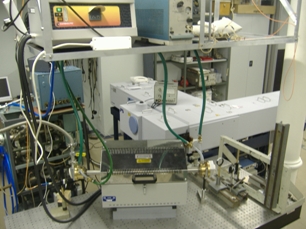
Scope. The laboratory possesses a Fourier transform spectrometer ISF-125 Bruker Optik GmbH, being unique in the region, with highest spectral resolution 0.01 - 0.006cm-1 operational, besides the absorption mode, in the emission with increased sensitivity. Combination with other spectral arrangements, single mode dye lasers and tunable diode lasers, facilities for producing alkali vapor, controlled electric and magnetic field and time-resolved detection provides all necessary equipment for a broad variety of most advanced experimental studies in the area. Basing on that, MOLPOL lab is involved in frontier research on obtaining highly accurate experiment based potential energy curves of ground and selected excited states of alkali diatomic molecules being of most acute interest for producing cold and ultracold species. Specifically, a systematic research provided first data on the ground state of the KCs molecule, a riddle of fully mixed singlet-triplet complex was resolved for NaRb and is in the way for NaCs and KCs, application of external electric and magnetic fields and time-resolved detection yielded unique data on dynamic parameters. A unique facility is developed for non-contact optical detection of electric field potential allowing testing of contact quality of open surfaces by detecting laser induced fluorescence.
Some of the expertise is summarised in monograph M. Auzinsh, R. Ferber, Optical Polarization of Molecules (Cambridge UP, 1995 and 2005) and 17 papers in 2005-2007 in Phys. Rev. Lett., Phys. Rev. A, J. Chem. Phys., J. Phys. B, etc.
 Staff. MOLPOL lab includes PI, six staff scientists, visiting scientists and students.
Projects. NATO Science for Peace "Optical Field Mapping" (2002-2007), EC Structural Funds, Latvian National Research Programme and Latvian Science Council grants, etc.
International cooperation. collaborative research, exchange of visiting scientists and students with a number of leading labs and experts in the field, such as W. Stwalley team at University of Connecticut, E. Tiemann's lab in Hannover University, A. Stolyarov group in Moscow State University and many others.
Archive of Spectra. The Archive of Spectra—a comprehensive collection of recorded Fourier Transform laser-induced fluorescence spectra of alkali diatomic molecules, classified by molecule and electronic transition—is available upon request. Requests may be addressed to Dr. Arturs Mozers, Head of the Laser Centre at the Faculty of Science and Technology, University of Latvia, or to Prof. Ruvin Ferber, Head of the MOLPOL (Molecule Optical Polarization) laboratory.
 The Laboratory of Astrospectroscopy of the Laser Centre focuses on the applications of high-resolution spectroscopy for space research:
- chemical composition of stellar atmospheres;
- nucleosynthesis and evolution of Galactic chemical composition;
- radial (Doppler) velocities;
- atoms and molecules in the interstellar and circumstellar environment.
High-resolution spectroscopy is one of the most powerful methods in astrophysics. The methodology concerns the use of stellar spectra, recorded under [very] high spectral resolution, in principle permitting the identifications of all spectral lines. These line profiles are then analyzed with respect to e.g. the varying chemical composition among stars in different stages of evolution. Besides being useful for the scientific goal proper, this methodology appears to be particularly promising in
assuring front-line work also in small research groups: already in a few nights of observing with some internationally accessible teleskopes (e.g. European Southern Observatory or on satellites) much data can be collected, whose analysis can be well pursued with only modest laboratory facilities;
this branch of astrophysics lends itself to collaboration with fields in atomic and molecular physics. The analysis of stellar spectra require extensive laboratory work bacause the number of species for which the spectrum is known accurately enough (line positions, line intensities, and line profiles) is still quite small. Furthermore, the needs of the observing community for laboratory data are continually evolving, particularly as technological developments opens new possibilities.
A significant experience have been gathered by the staff of Laboratory in interpretation of atomic and molecular absorption spectra formed at physical condition typical for cool stars with effective temperatures of ~ 3000 ÷ 5000 K. The standard methods (colours, ionization balance, excitation analysis, etc.) and stellar atmospheric models are used to determine fundamental stellar parameters and abundances. Main scientific results are published in the leading editions of the world: Astronomy & Astrophysics, Monthly Notices of the Royal Astronomical Society, and Astrophysics and Space Science. A fruitful scientific collaboration with N. Copernicus Astronomical Center (Poland), Free University of Brussels (Belgium), Special Astrophysical Observatory (Russia), National Central University (Taiwan) , and University of Aarhus (Denmark).
Page 1 of 2